


News
Latest Lion Aid News
The shrinking horizon
Friday 20th March 2026
|
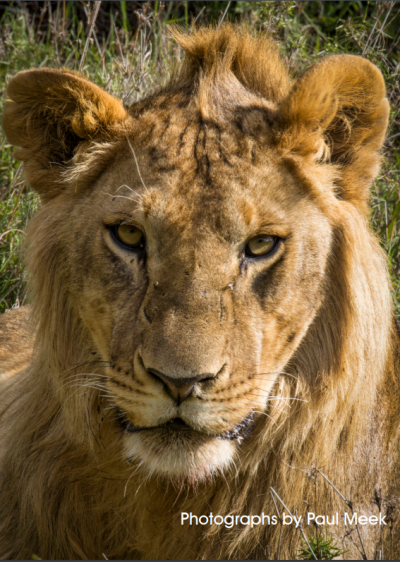
The tall grasses of the Mara didn’t part as easily as they once did. For a magnificent lion we will call Tau, a pride male whose golden mane was now peppered with the grey of many seasons, the world was becoming a much smaller, quieter place. The Shrinking Horizon Decades ago, Tau’s ancestors ruled an endless sea of amber. Today, that sea is being hemmed in by invisible fences and the steady hum of human expansion. As the sun dipped below the horizon, painting the sky in bruises of purple and gold, Tau let out a roar. It was a magnificent sound—a low, rhythmic thrumming that should have been met by an orchestra of answering calls from neighboring prides. Instead, there was only the wind. The Mathematical Tragedy Tau watched his two remaining cubs tumble in the dust. They were full of fire, unaware of the devastating maths of their existence. In the mid-20th century, there were likely over 200,000 lions roaming Africa. Today, the LionAid Assessment reveals a terrifying collapse: The Southern & Eastern Strongholds: Tau is one of only 13,014 wild lions left in these regions.
The Silent Threats The decline wasn't just about the lack of space; it was a ghost story told in three parts: Genetic Isolation: With so few lions left, Tau’s cubs may never find unrelated mates. Without "wild corridors," the pride becomes an island, and the bloodline weakens. Conflict at the Edge: As farms push into the savanna, the wild prey vanishes. When a lion eyes a cow out of desperation, the human retaliation is swift and final. The "Paper Lion" Illusion: While some claim there are more, LionAid warns that those numbers often include lions in small, fenced enclosures. For a truly wild king like Tau, the kingdom is nearly gone. A Flicker of Gold The survival of these "Kings" now rests not on their claws or their strength, but on the choices of a different species entirely. To save the lion, we must protect the 13,356 that remain with a ferocity that matches their own. As night fell, Tau settled into the grass. He was a king of a fragmented kingdom, waiting for a dawn where his roar might once again find an answer in a world that still has room for him.
While Tau is a fictional character, his story is the lived reality for the remaining 13,014 lions in Eastern and Southern Africa. He represents the silent struggle of a species being pushed into ever-smaller corners of the map. We created Tau to give a face to a number that is hard to wrap our heads around. It is easy to ignore a statistic like 13,356, but it is impossible to ignore the sight of a king losing his home. Tau helps us visualize the habitat fragmentation and genetic isolation that our researchers document every day in the field.
Thank you so much for any support you can give us.
Tags: lions, extinction, threats, the shrinking horizon Categories: Genetics, Trophy Hunting, Extinction, Human/Wildlife Conflict, Population declines |
Add a comment | Posted by Chris Macsween at 17:47


